



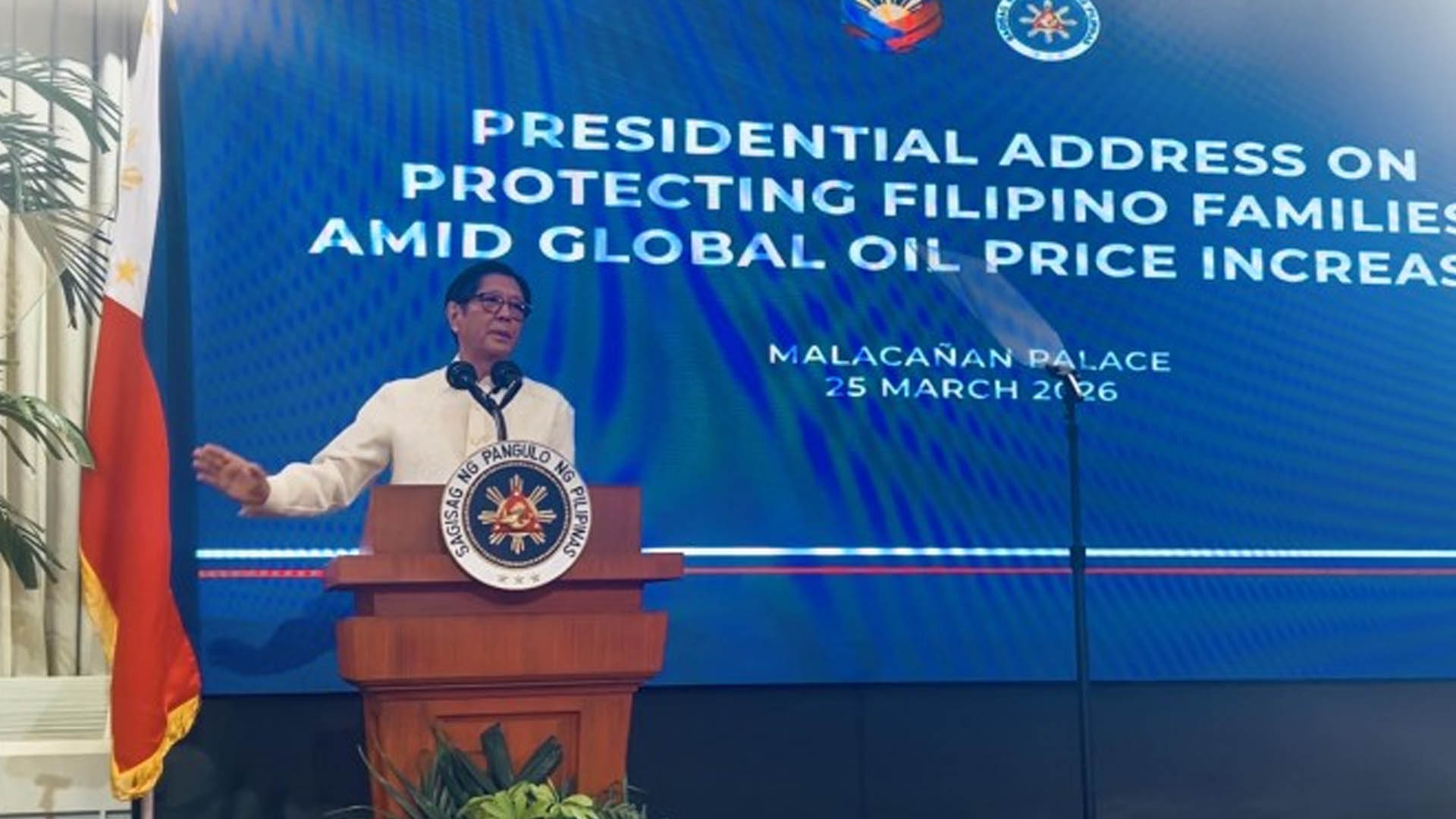







President Ferdinand R. Marcos Jr. said Wednesday that the government has extended assistance to more than 16,000 overseas Filipino workers (OFWs) affected by the ongoing conflict in the Middle East, while repatriation efforts remain in full swing.
Addressing the nation in a speech delivered at Malacañan Palace, Marcos said the government is putting a premium on the safety of OFWs, noting that more than 2,000 have already been repatriated.
“And we will continue to do this until the war ends or until we have repatriated all of our nationals back home here to the Philippines,” he said.
The President said the Philippines immediately coordinated with host countries from the Middle East to ensure the protection and safety of Filipino workers under their jurisdiction amid the escalating tensions in the Gulf region.
Despite the relief efforts, Marcos lamented that a Filipino caregiver in Israel was among the early casualties after being caught in a bombing incident while assisting her elderly ward.
He urged OFWs to avoid leaving conflict areas on their own and instead coordinate with authorities to ensure their safe evacuation.
He noted that the government has since established systems for the orderly repatriation of Filipinos who wish to return home.
“And since the time that we have set up the systems for repatriation, nakauwi na ang mahigit 2,000 OFWs (Since the time we set up the systems for repatriation, more than 2,000 OFWs have already returned home),” he said.
Marcos noted that assistance provided to affected OFWs includes food, shelter, medical care, transportation, and financial aid, benefitting both those who have been repatriated and those who remain abroad.
He added that the government has so far mounted four chartered flights to bring home OFWs, with more flights being arranged.
He said repatriation efforts involve gathering OFWs from different locations into a central point before transporting them back to the Philippines.
Marcos said authorities are ensuring that all movements are coordinated to prevent risks, particularly in conflict zones.
He also warned against unauthorized travel, saying convoys may be misidentified and could lead to dangerous encounters.
“At sila naman ay dahan-dahan ay ginagawa namin ng paraan upang umuwi. Ang mahirap ay ang pag-charter ng eroplano at saka ang paglipat kahit ‘yung by land. Noong araw, sinabi ko sa kanila huwag kayong basta’t magsasarili (We are gradually making arrangements for their return. The difficult part is chartering planes and organizing land transfers. Before, I told them not to act independently),” Marcos said.
“Dahil kung mag-convoy kayo, ‘pag nasa 10,000 feet ‘yung aeroplano, hindi nila malaman kung ‘yun ba ay mga militar o ‘yun ba ay sibilyan. Baka magka-problema, magka-misencounter kung tawagin (Because if they travel in convoys, when viewed from 10,000 feet in the air, it is difficult to tell whether they are military or civilian. This could lead to problems – a misencounter, as it is called).”
The President said the government plans to increase the frequency of chartered flights from once a week to twice weekly, depending on clearance from local authorities.
Some OFWs, he added, have also been able to return through commercial flights. (PNA)