



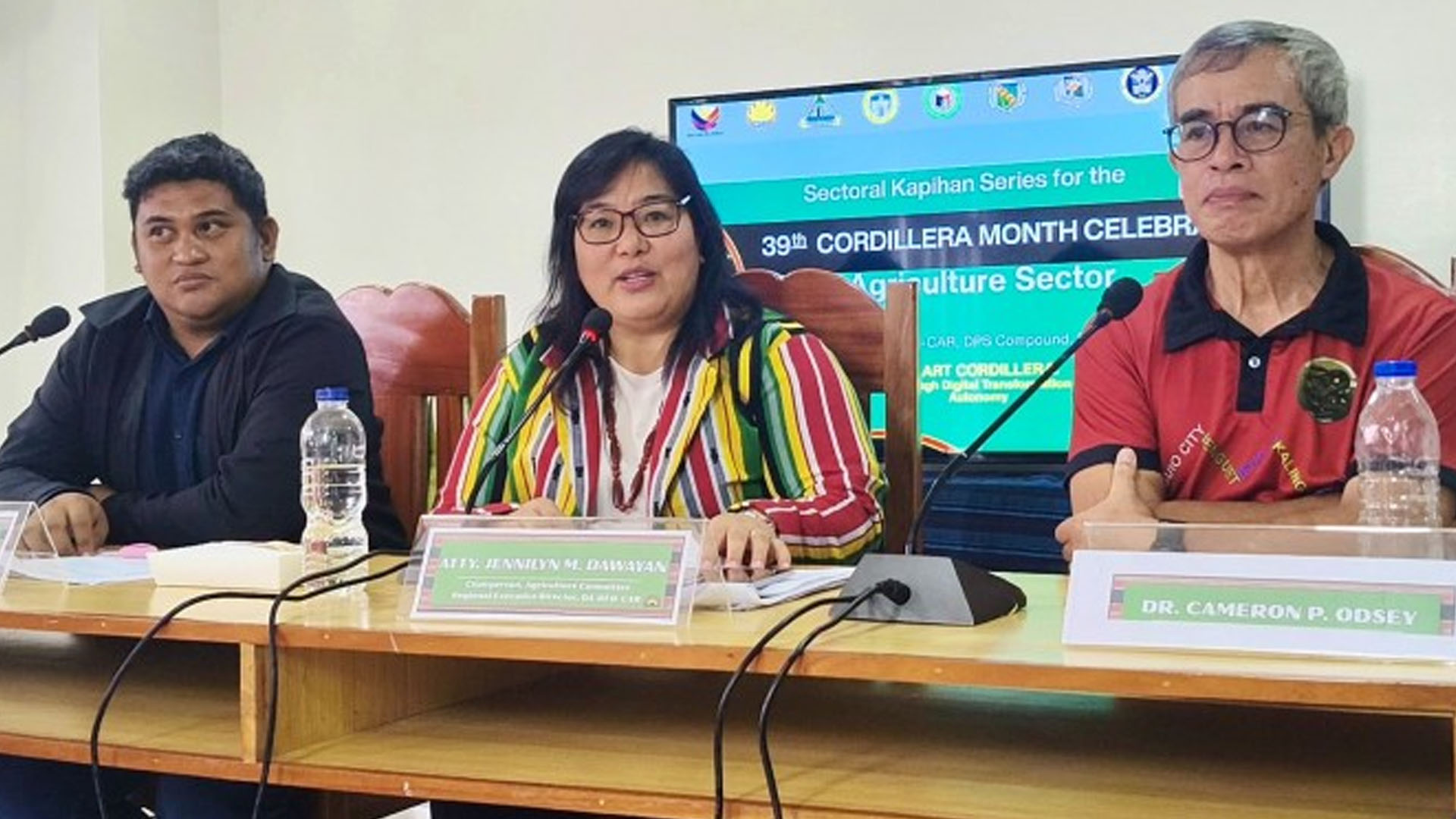







The Department of Agriculture-Cordillera (DA-CAR) said on Wednesday that converting the region to an autonomous region would boost its specialized agricultural produce and allow the adoption of plans and programs that fit the region’s unique needs.
“With autonomy, we can design programs for Cordillera farms not adopted from somewhere else – programs that are more appropriate and effective for us,” said DA-CAR Regional Director Lawyer Jennilyn Dawayan during the Kapihan of the agricultural sector committee of the Regional Development Council (RDC).
The Cordillera is celebrating its 39th anniversary as an administrative region, still hoping to achieve autonomous status.
Dawayan said the agriculture sector has many policies, but most apply to the lowlands. “We adopt them because they are policies, but agriculture in the Cordillera is unique – the terrain is different. That is why when our officials visit the farms, they are surprised at how difficult food production is. We have different crops too. Even farming practices are different,” she said.
She noted that farming machinery is designed for huge sizes and is functional for flat and wide farmlands. “Most of our farms are on mountain slopes, and the machines cannot be carried; they are also inapplicable as we have small farmlands,” she said.
The director also discussed the national agriculture office’s priorities on rice and corn. “We have less rice production, and the basis for support is quantity, which is why we do not get to have lots of programs and projects,” she said.
Rice is produced in larger quantities in Lower Kalinga towns and Apayao. There is also rice in Upper Kalinga, Mountain Province, Benguet, and Ifugao, but heirloom rice varieties are mostly for home consumption and used for special occasions and for producing rice wine for native rituals.
She also mentioned strawberries, which are produced in Benguet, some parts of Bauko, Mountain Province, and Baguio City – considered a high-value crop but not included in the national program.
“It is just us who have it, which is why there is no national support. But if we are an autonomous region, we can decide to put it among our priorities and provide funds to improve productivity and marketing,” she said.
Dr. Cameron Odsey, an autonomy advocate and former DA-CAR regional director who served the agency for more than 30 years, said, “Nobody understands our systems but us because they are time-tested systems. With local decision-making, we do not just preserve part of our culture but incorporate farming practices to have better food production yield.”
He said autonomy should be fully realized to ensure that farming practices are integrated into the development plan, allowing for greater focus and the creation of design solutions suited to the region’s landscape.
Odsey said House Bill 6981 was filed on Dec. 18, 2025, co-authored by the seven Cordillera representatives and two party-list representatives from the region.
“We have set a roadmap and are targeting to have the plebiscite together with the 2028 election,” Odsey said.
The Cordillera was made an administrative region through Executive Order 220 of then-President Corazon Aquino while it was being prepared to become an autonomous region, placing contiguous provinces with similar cultures of Indigenous Peoples as part of the region.
It was also included, together with Bangsamoro, as one of the two regions in the country included in the Constitution that will become autonomous. (PNA)