



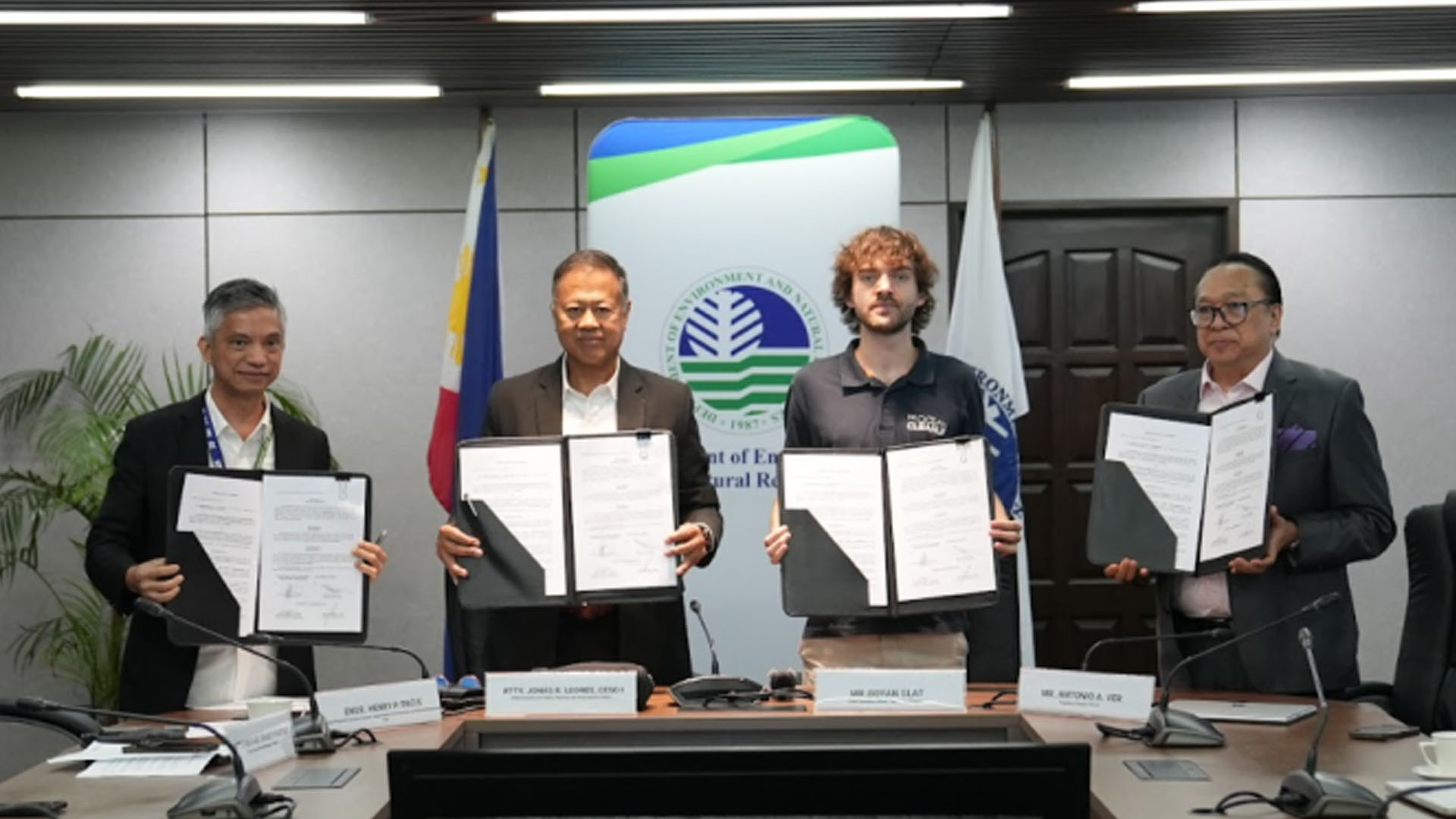







The Philippine government has signed a five-year partnership with Rotterdam-based non-profit group The Ocean Cleanup to remove floating waste from the Pasig River and use low-cost innovative technologies to reduce plastic pollution before it reaches Manila Bay and the ocean.
The Department of Environment and Natural Resources (DENR) said the partnership with The Ocean Cleanup is part of a broader strategy to intercept plastic waste already present in waterways, while complementing existing policies aimed at reducing pollution at its source and supporting the objectives of the Pasig River rehabilitation efforts.
“The Pasig River has carried the burden of our consumption habits for far too long,” Environment Secretary Juan Miguel Cuna said as quoted in a news release on Thursday.
“We cannot allow this river to remain a pipeline of plastic to the ocean. This agreement is a decisive step toward breaking that cycle,” he added.
The DENR said the partnership combines waste interception technologies with the government’s regulatory efforts under Republic Act 11898 or the Extended Producer Responsibility (EPR) Act, which requires large companies to recover and recycle plastic packaging they produce.
The Ocean Cleanup, known for developing large-scale river and ocean cleanup systems, said it has deployed 21 interceptors across 10 countries and has collected more than 52 million kilograms of waste from aquatic environments as of April 2026.
Its technology uses solar-powered automated systems designed for high-volume waste capture, which is expected to be adapted to address the heavy waste load along the Pasig River system.
Cuna said the strategic initiative aligns with President Ferdinand R. Marcos Jr.’s directives under the “Pasig Bigyang Buhay Muli” project.
“By integrating The Ocean Cleanup’s cutting-edge solutions with the government’s local restoration programs, the partnership aims to fulfill the President’s vision of a clean, navigable, and vibrant Pasig River that serves as a cornerstone for sustainable urban renewal and national pride,” he said.
Cuna added that it is also part of The Ocean Cleanup’s 30 Cities Program, which aims to scale interceptor deployments across key cities in Asia and the Americas to reduce plastic flowing from rivers into oceans before the end of the decade.
The partnership would also focus on knowledge transfer to the Pasig River Coordinating and Management Office under the DENR-National Capital Region (NCR) to enable local authorities to sustain cleanup operations beyond the project period.
“This ensures that once the project reaches maturity, local authorities will be fully equipped with the specialized skills and technological insights necessary to maintain the river’s cleanliness for future generations,” Cuna said.
Meanwhile, Boyan Slat, Founder and CEO of The Ocean Cleanup, noted the importance of strong partnerships to effectively address plastic pollution, a global problem.
He also expressed optimism in working with the DENR, including local partners, to strengthen existing efforts and help drive lasting results.
“This agreement with DENR brings together local leadership and global expertise to accelerate action in one of the world’s most important coastal regions. By combining research, data, and operational experience, we can identify where our Interceptor technology will have the greatest impact and help stop plastic before it reaches Manila Bay and the ocean,” Slat said.
“The Ocean Cleanup has deployed solutions around the world and demonstrated that large-scale reduction of plastic pollution is achievable,” he added.
The DENR said preparations for deployments in the Manila Bay region are already underway, with The Ocean Cleanup surveying nearly 100 sites to determine priority locations.
Aside from the sites along the Pasig River, the organization is preparing to deploy its first interceptor barrier on the Meycauayan River in Bulacan to reduce plastic leakage into Manila Bay.
The Ocean Cleanup’s work in Manila is also being supported by Energies PH, a renewable energy developer in the country focused on breakthrough clean technologies.
“This partnership allows us to confront the problem from both ends — by holding producers accountable and by deploying the technology needed to intercept the waste already in our waters,” Cuna said. (PNA)