



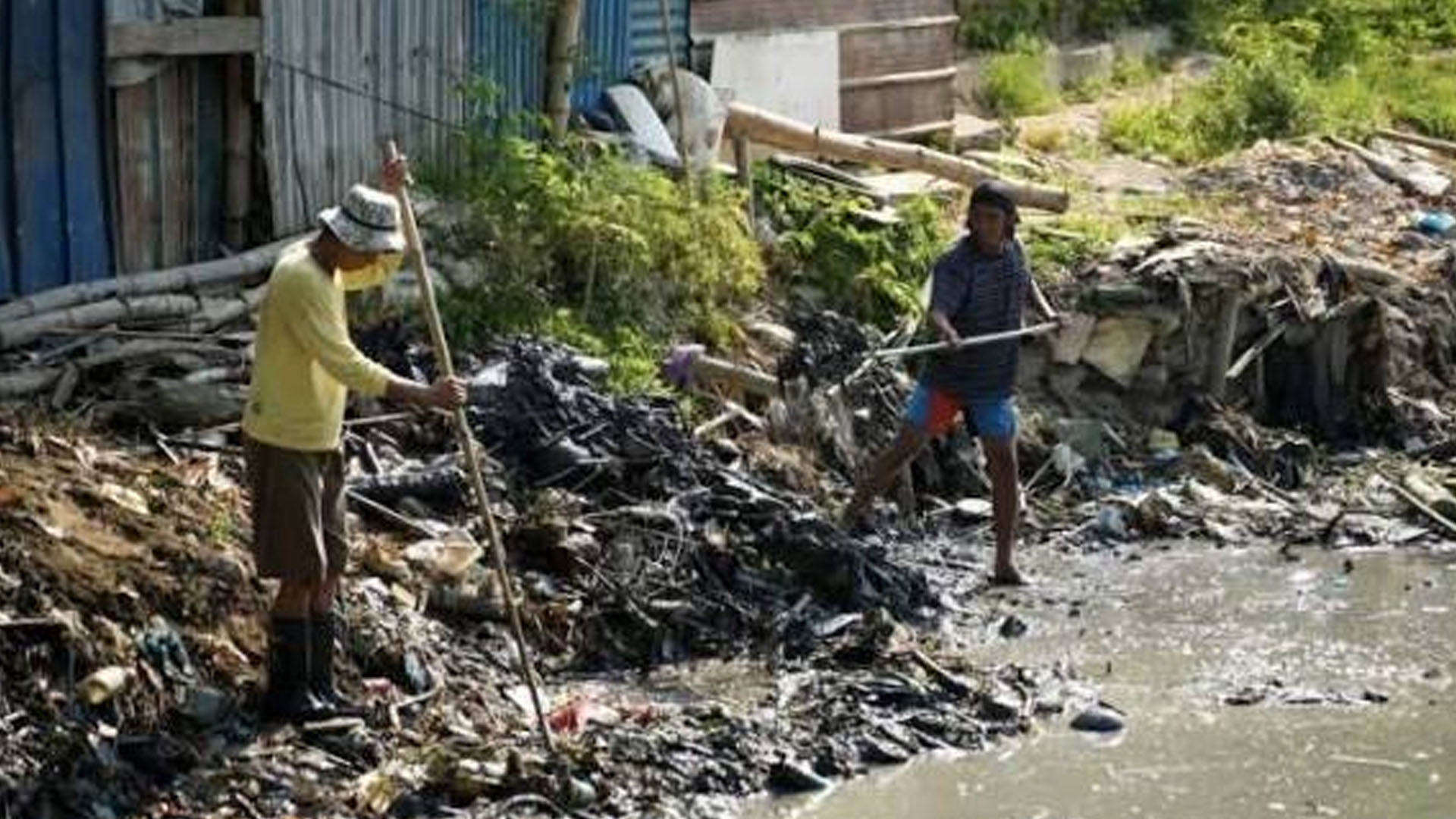







This town’s river restoration project, in cooperation with the provincial government and village officials, extracted a total of 6,000 cubic meters of waste since it started this year.
Mayor Patrick Caramat, in an interview on Friday, said this is 56 percent of the town’s annual total garbage collection.
“Mahigit walumpung porsiyento ng materyal na iyon ay makapal na silt at mga naipong dumi — mga putik, buhangin, at iba pang materyales na matagal na naipon at nagpabawas sa kakayahan ng ating mga ilog na umagos nang maayos (Over 80 percent of the waste materials are silt and mud, soil, and other materials that were accumulated, and affected the river’s capacity to flow),” he said.
Caramat said the waste materials were given to schools and residents who need backfill, and the town’s material recovery facility.
“We have cleared the bottlenecks of Parongking River and secured over four kilometers of the Marusay River in Phase 1. Now, we are shifting toward true watershed-wide management as Marusay River Phase 2 scales up exponentially, targeting a massive sixteen-kilometer corridor cutting through eight barangays,” he said.
He said the local government has mapped out the 25 creeks and 13 more that are not originally on the map.
“By bringing these forgotten channels into our predictive models, we prevent them from becoming illegal dumping grounds and the sources of unpredictable flash floods,” he said.
“We have also cleaned our drainage canals. In the almost three kilometers canal in the Poblacion area, with only 250 meters cleaned, we were already able to remove 4.5 cubic meters of waste,” he added.
The bottom-up approach allowed the local government to form the Calasiao Flood Resilience and Mitigation Management Council to formulate a concrete plan to address systemic flooding, he said.
The project, he said, provided jobs to residents as the Provincial Government of Pangasinan directly employed 40 displaced workers through the TUPAD program.
“The long-term dividends of this work are already felt in our fields, where approximately seventy farmers in Barangay Quesban have finally regained a steady, viable source of irrigation. By restoring the river’s hydraulic function, we are safeguarding our food supply and protecting the livelihoods of the people who feed us,” Caramat said. (PNA)