



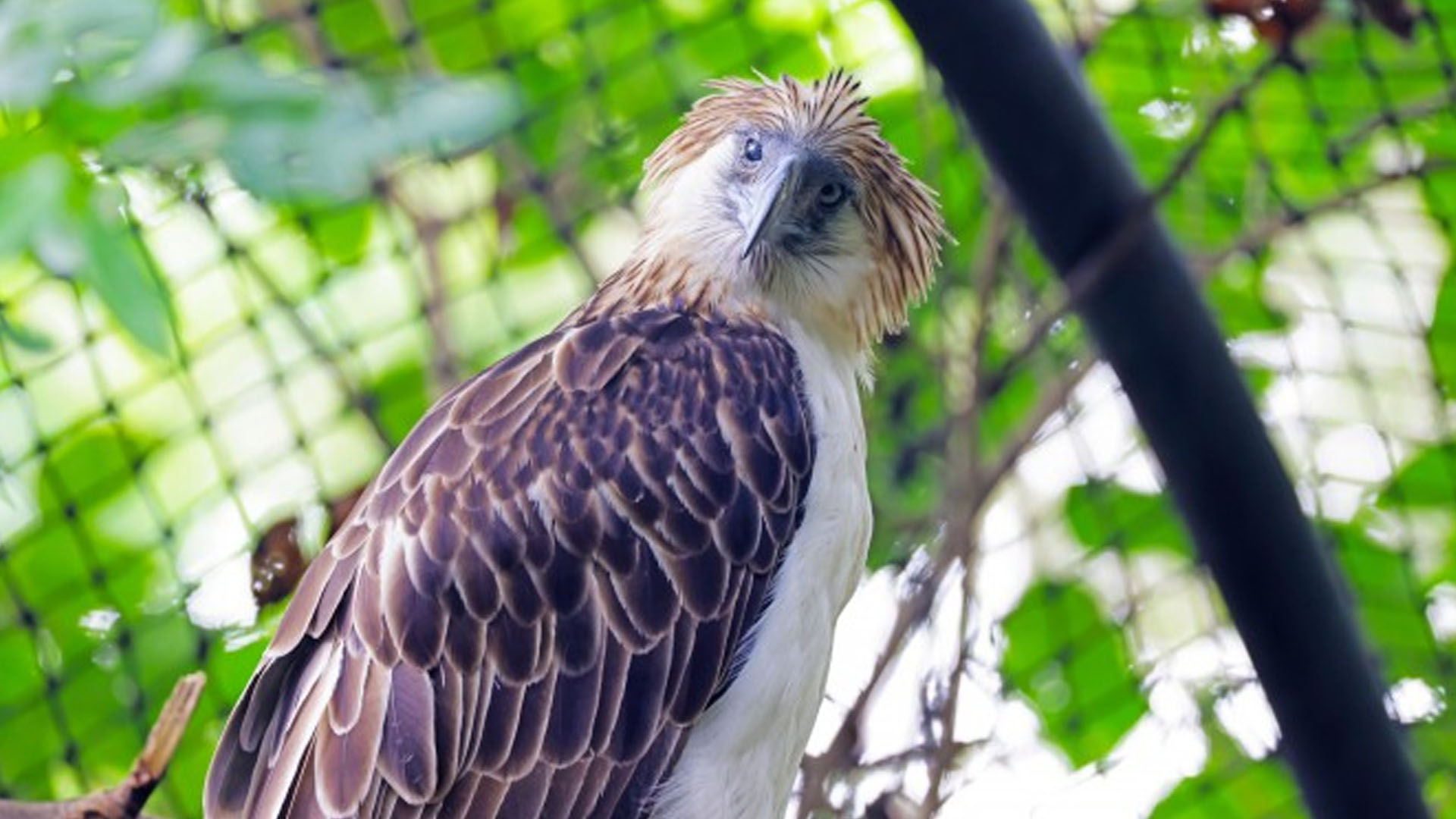







A Philippine Eagle rescued as a juvenile in the early 1980s has surpassed the typical lifespan of its species in captivity, becoming a rare living benchmark of how far, and how long, Philippine conservation has had to work to keep its most iconic bird alive.
The Department of Environment and Natural Resources (DENR) said the Philippine eagle named “Girlie” is now in her mid-40s, outliving the expected lifespan of the Philippine Eagle.
“Girlie” was rescued in 1982 after a slingshot injury left her with a damaged wing and blindness in one eye, and has since lived under human care.
In 2009, she was transferred to the Ninoy Aquino Parks and Wildlife Center at the heart of Quezon City.
“Girlie is more than a resident of a city park; she is a living reminder of our shared responsibility,” Environment Secretary Juan Miguel Cuna said in a statement.
He said the Philippine eagle has become the living emblem of an alliance between the DENR and the Philippine Eagle Foundation (PEF).
“The DENR will continue to work with partners like the Philippine Eagle Foundation to protect habitat, support science‑based recovery, and bring conservation into the daily lives of Filipinos,” Cuna added.
The Philippine eagle is one of the rarest eagles in the world and can only be found on four islands in the Philippines: Luzon, Samar, Leyte, and Mindanao.
The PEF said it is considered one of the largest and most powerful forest raptors.
They are also listed as critically endangered by the International Union for Conservation of Nature (IUCN), with only an estimated 400 pairs left in the wild.
Girlie’s life has unfolded alongside key phases in Philippine Eagle conservation, particularly the evolution of the collaboration between the DENR and the PEF, starting from early captive-breeding work into a broader ecosystem protection.
In the 1980s, Girlie was paired with a male eagle named “Tsai”, as part of pioneering captive-breeding efforts.
The pair produced the first fertile egg laid by a natural pair of Philippine Eagles in captivity, a breakthrough that marked an early success for the program.
Although the chick did not survive, the result helped shift conservation thinking toward long-term, multi-pronged recovery strategies beyond breeding alone.
“Government brings policy and reach; PEF brings field science and years of hands‑on experience,” Cuna said.
“Our collaboration shows what government and civil society can achieve when we align expertise with policy.”
The DENR said that today, conservation work focuses heavily on protecting remaining forest habitats, which are critical to the survival of an estimated few hundred breeding pairs left in the wild.
PEF Executive Director Dennis Salvador said the alliance with the DENR underscores the hard work of habitat protection, securing large tracts of continuous forest, working with local communities to reduce hunting and disturbance, and applying science to monitor the remaining population.
“Years spent tracking eagle pairs, mapping their forest territories, and studying population trends in the field helps government use this data to create official protection zones and enforce environmental laws,” he said.
“The partnership succeeds because it connects our research directly to national enforcement. Saving our National Bird requires basing our joint actions on verified field data.”
Since her transfer to the city in 2009, “Girlie” has become one of the most recognizable Philippine Eagles in the country.
Her presence in an urban public park has also made her a key figure in conservation education, offering visitors a rare opportunity to see the species up close and better understand the stakes of its survival.
“She gradually emerged as the park’s ‘poster bird’ for Philippine Eagle conservation,” Salvador said.
While Girlie cannot be released back into the wild, conservationists view her survival as part of a broader conservation picture, where success is measured not only by population trends in forests but also by the sustained protection, care, and awareness built over the years.
Her longevity is a clear outcome of Philippine conservation: that progress is often slow, incremental, and dependent on long-term cooperation between government, scientists, and the public.
“Her story is not a tidy success; it is a ledger of small victories and persistent losses. It is also, increasingly, a test of whether a government and a nonprofit can translate decades of collaboration into the political will and resources necessary to protect the forests that sustain the eagle,” the DENR said.
On ordinary days, visitors pass by Girlie’s enclosure with children amazed by her “grandiose” and her crest, while elders pause to read the placard.
“Girlie” then watches with the slow, patient gaze of something that has outlived many expectations, serving as both an exception and a reminder that conservation gains are possible, but they are earned one decade at a time. (PNA)